TL;DR: Digital experiential in Dubai combines AR, VR, AI, and interactive content to create memorable emotional moments. Effective strategies blend physical and digital experiences across the full marketing funnel, focusing on human connection. Future trends include AI-native content, phygital flywheels, and multi-sensory exclusivity tailored for luxury consumers.
In Dubai, digital experiential only works when technology disappears and the human moment becomes the headline.
Dubai Mall campaigns using contextual AR and interactive content achieve 340% higher conversions and a 73% brand awareness lift. That is not a lucky outcome. It is what happens when digital experiential is treated as a strategic discipline rather than a technology showcase. Many brand leaders still confuse digital experiential with flashy screens or novelty gadgets. The reality is sharper: it is a full-funnel strategy that fuses digital technology with real human emotion to create measurable brand outcomes. This guide covers the core concepts, strategic roles, best practices, future trends, and the hard lessons that separate brands who win in Dubai from those who just spend.
Key Takeaways
| Point | Details |
|---|---|
| Human-first strategies win | The most effective digital experiential campaigns prioritise meaningful human engagement, not just technology for its own sake. |
| Measure what matters | Focus on metrics like dwell time and social amplification to truly gauge experiential success, especially for Dubai brands. |
| Hybrid approaches excel | Combining digital scale with emotional, in-person depth delivers full-funnel marketing and branding impact. |
| Luxury needs exclusivity | Dubai’s high-value audiences respond best to exclusive, multisensory experiences that drive word-of-mouth and loyalty. |
What is digital experiential? Core concepts for Dubai brands
Digital experiential is the practice of merging digital technologies, think augmented reality (AR), virtual reality (VR), artificial intelligence (AI), and interactive content, with real-world brand engagement. It is not about deploying the most advanced tool available. It is about creating a moment that a consumer feels, remembers, and talks about. The technology is the vehicle. The emotion is the destination.
Dubai makes this discipline uniquely powerful. The city’s consumer base is among the most tech-savvy and affluent in the world. Expectations for luxury, exclusivity, and innovation are embedded in everyday life. A standard brand activation that might impress in another market will barely register here. Dubai audiences expect to be surprised, and they expect that surprise to feel personal.
The pillars of a strong digital experiential strategy include:
- AR and VR immersion: Creating environments where consumers step inside the brand story rather than observe it from the outside.
- AI-driven personalisation: Using real-time data to tailor content, offers, and interactions to individual preferences at scale.
- Multi-sensory design: Engaging sight, sound, touch, and even scent to deepen emotional memory and brand recall.
- Data-driven content: Building activations that learn and adapt based on how audiences actually behave, not how planners assume they will.
- Phygital integration: Seamlessly blending physical environments with digital layers so the experience feels unified, not bolted together.
Agencies like Big Group, TheOtherGuyz, Lightblue, and Momentum are already pushing these boundaries for brands operating in Dubai, proving that the infrastructure and creative talent exist right here in the market.
“A 73% brand awareness lift is not a campaign metric. It is proof that when digital and physical collide with intention, brands stop being seen and start being felt.”
For marketing executives operating in Dubai, this is the baseline. The brands winning today are not just running digital campaigns. They are engineering experiences that consumers choose to re-enter.
Marketing vs. branding: Digital experiential’s role across the funnel
One of the most common strategic errors is treating digital experiential as either a pure marketing tool or a pure branding exercise. It is both, and knowing when to use it for which purpose changes everything.
Marketing uses digital experiential for short-term impact: driving traffic, generating conversions, capturing attention in a crowded environment. Branding uses it for long-term relationship building: creating emotional depth, earning loyalty, and generating word-of-mouth that no paid media budget can replicate. Optimal results come from hybrid strategies that serve both goals simultaneously.
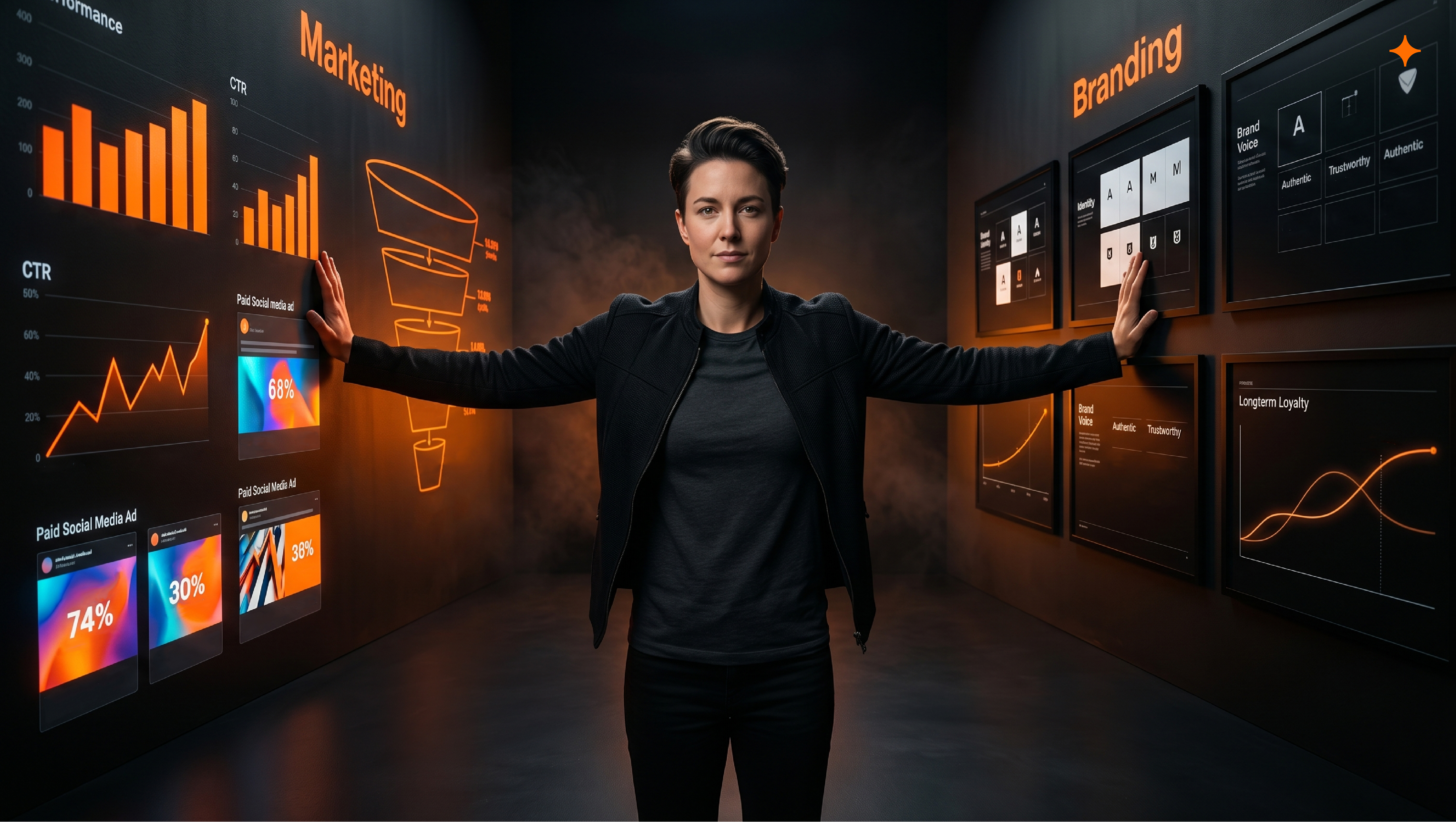
| Dimension | Marketing focus | Branding focus |
|---|---|---|
| Time horizon | Short-term | Long-term |
| Primary goal | Conversion, traffic | Loyalty, emotional connection |
| Funnel stage | Top and bottom | Middle and retention |
| Key metric | Click-through, sales | NPS, brand recall, WOM |
| Dubai example | AR product trial at point of sale | Immersive brand world at a flagship event |
Here is how a Dubai brand might deploy digital experiential across the full funnel:
- Awareness: Launch an AR filter on social platforms tied to a cultural moment, Ramadan, Expo legacy events, or a luxury product drop, to generate organic reach.
- Consideration: Deploy an interactive digital installation at a high-traffic venue like Dubai Mall to let consumers explore product benefits in an immersive, low-pressure environment.
- Conversion: Use AI-personalised content at the point of purchase to surface the right offer for the right consumer at exactly the right moment.
- Retention: Build a phygital loyalty programme where physical purchases unlock exclusive digital experiences, creating a loop that rewards continued engagement.
- Advocacy: Design shareable moments, visual, emotional, or surprising, that consumers want to broadcast to their networks, turning customers into brand amplifiers.
The brands that focus on building brand loyalty through this kind of full-funnel thinking consistently outperform those chasing single-stage wins. The funnel is not a straight line in Dubai. It is a spiral, and digital experiential is what keeps consumers moving through it.
Best practices: Human-first, high-impact digital experiential
The single biggest mistake in digital experiential is building for the technology rather than the human. A VR headset does not create connection. A story told through a VR headset can. The distinction sounds simple, but it is where most activations fall apart.
Prioritise human-first, hybrid designs that start with a genuine consumer need or emotional truth, then select the technology that serves it best. In Dubai’s market, where consumers are exposed to world-class experiences constantly, anything that feels like a tech demo without a human core will be dismissed quickly.
When using AI for personalisation, ethical data practices are not optional. Dubai consumers, particularly in the luxury segment, are protective of their privacy. Transparency about how data is collected and used builds trust rather than eroding it. An AI-powered personalisation example that respects these boundaries can dramatically increase engagement without the reputational risk.
Pro Tip: Stop measuring digital experiential success by impressions alone. Track Return on Experience (ROX) using active dwell time and social amplification. Dubai digital experiential activations average 18 to 24 seconds of active dwell time compared to just 3 to 4 seconds for a standard video view. That gap represents real attention, and real attention drives real outcomes.
Here are the core dos and don’ts for Dubai brand managers:
- Do start with a clear emotional or behavioural objective before selecting any technology.
- Do design for shareability, Dubai consumers are highly active on social platforms and will amplify what genuinely moves them.
- Do measure dwell time, social amplification, and repeat engagement as primary success indicators.
- Don’t deploy technology because it is new. Deploy it because it solves a specific human problem better than anything else.
- Don’t ignore accessibility. Experiences that exclude segments of your audience narrow your impact and signal poor brand judgment.
- Don’t treat data collection as a bonus feature. Build it into the experience architecture from day one.
The brands that follow these principles consistently outperform those chasing novelty. In Dubai, the bar for what counts as impressive is already high. Human relevance is what clears it.
Future trends: The next frontier for digital experiential in Dubai
The next wave of digital experiential is already forming, and Dubai is positioned to be at its centre. Three forces are shaping what comes next: AI-native creative, phygital flywheels, and multi-sensory exclusivity designed for high-net-worth audiences.
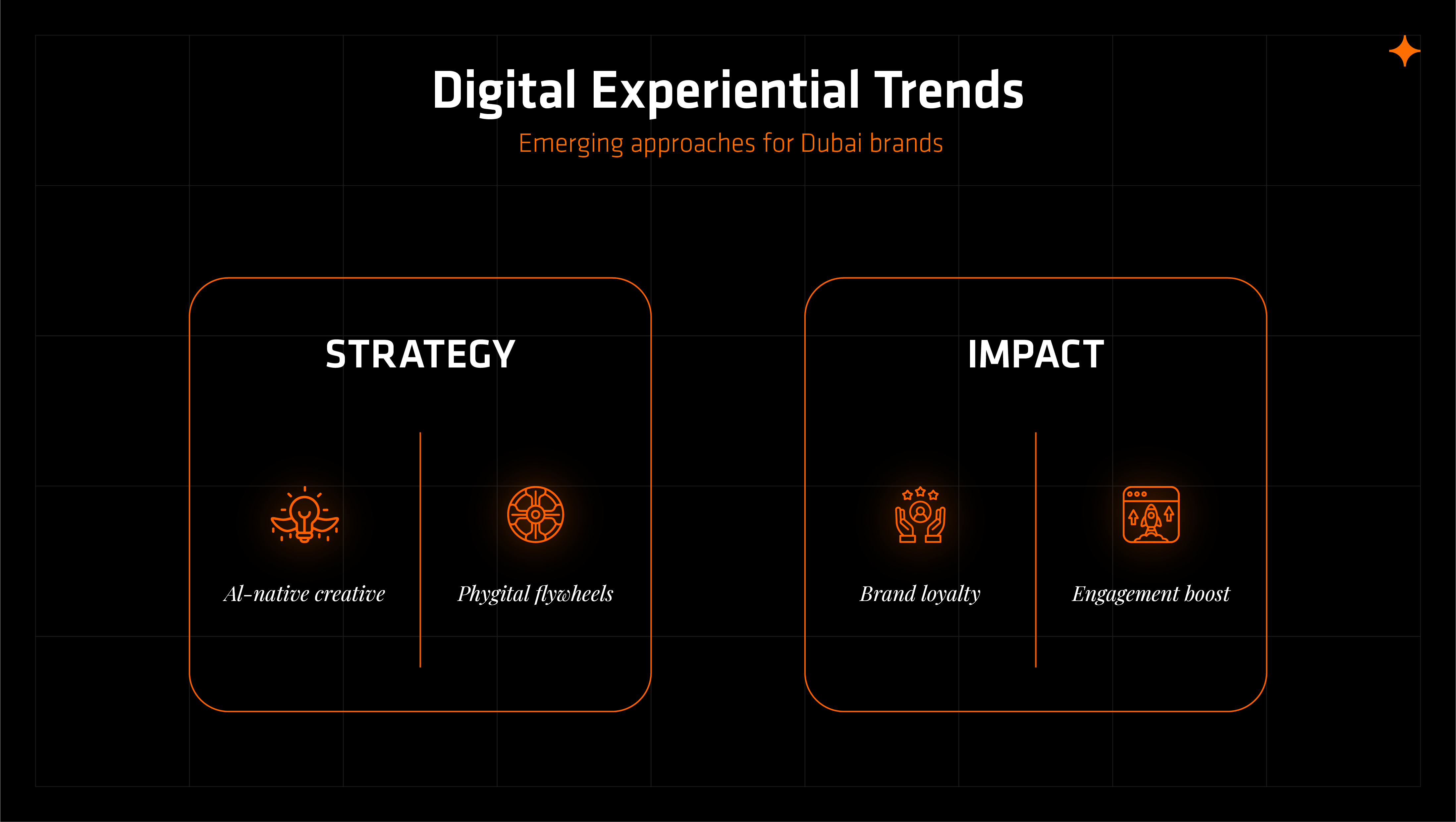
AI-native creative, sometimes called “liquid creative,” refers to content that generates and adapts itself in real time based on audience signals. Rather than a fixed activation, the experience evolves with each interaction. For Dubai brands targeting luxury consumers, this means every touchpoint can feel bespoke without the cost of truly custom production.
Phygital flywheels are closed-loop systems where physical and digital interactions feed each other continuously. A consumer visits a flagship store, triggers a digital reward, shares it online, and that share drives new physical footfall. The loop compounds over time, building brand equity with each rotation.
Multi-sensory exclusivity is becoming the defining expectation of Dubai’s luxury and high-net-worth (HNW) segment. Exclusivity for luxury audiences drives 20 to 50% of purchase value through word-of-mouth, making scarcity and sensory richness a direct revenue lever, not just a brand nicety.
| Trend | Typical activation | Dubai-specific brand outcome |
|---|---|---|
| AI-native liquid creative | Real-time personalised content at events | Higher dwell time, stronger recall among HNW consumers |
| Phygital flywheels | Physical purchase unlocks exclusive digital content | Increased repeat visits, measurable loyalty loop |
| Multi-sensory exclusivity | Invitation-only immersive brand environments | WOM-driven sales lift of 20 to 50% |
“In Dubai’s luxury market, exclusivity is not a positioning strategy. It is a purchase trigger. Brands that engineer scarcity into their digital experiential activations are not just creating buzz. They are directly influencing buying decisions.”
For executives planning 2026 and beyond, the strategic recommendation is clear: invest now in the infrastructure that supports these trends, data architecture, AI capability, and phygital integration, before they become table stakes.
What most brands miss about digital experiential in Dubai
After working with brands across Dubai since 2016, we have watched the same pattern repeat. A brand invests in a spectacular digital activation, the technology is impressive, the production value is high, and the engagement numbers are disappointing. The reason is almost always the same: the experience was designed to impress the brand team, not to connect with the consumer.
Dubai’s market is sophisticated enough to see through novelty instantly. What earns loyalty here is emotional resonance, the feeling that a brand genuinely understands who you are and what you value. That cannot be manufactured by technology alone. It requires a deep understanding of the audience, a clear brand truth, and the discipline to let those two things drive every creative decision.
The hybrid approach, balancing analogue warmth with digital precision, emotional storytelling with measurable outcomes, is where the real opportunity lives. Our Dubai client success stories consistently show that the activations generating the strongest long-term brand trust are not the most technologically complex. They are the most human. In a market defined by luxury and exclusivity, being genuinely relevant to a consumer is the ultimate premium.
Ready to make digital experiential work for your Dubai brand?
The gap between brands that understand digital experiential and those that execute it with measurable impact is wider than most executives realise. Almost Impossible has been closing that gap for Dubai brands since 2016, combining strategic rigour with creative work that actually moves people.
If you want to see what this looks like in practice, explore our Dubai client work to understand the range of outcomes we have delivered. For a specific example of immersive digital experience done right, the Bullet Train VR project shows exactly how technology and human storytelling combine. You can also see more projects across industries and formats. When you are ready to start a conversation, we are here.
FAQs
What makes digital experiential especially effective in Dubai?
How do you measure the ROI of digital experiential campaigns?
What are some mistakes Dubai brands make with digital experiential?
Which industries in Dubai benefit most from digital experiential?
Recommended

Start a Project
Have a challenging brief? We thrive on the impossible. Let's build something world-class together.
Get in touch
Join the Team
Obsessed with details? We're always looking for world-class designers and engineers.
View openingsFollow the Journey
See what we're building, reading, and learning. Connect with us on LinkedIn.
Connect on LinkedIn