
Creative strategy that drives real brand engagement
A practical guide to creative strategy: how to set clear goals, define audience focus, build a distinctive voice, and choose the right channel mix to drive real brand engagement.
Published
Apr 29, 2026
Reading Time
13 min read
Author
Almost Impossible
TL;DR: Creative strategy aligns creative efforts with clear business goals and audience insights. Effective strategies require courage, discipline, and adaptability to stand out in competitive markets. Combining human creativity with AI support enhances testing, scaling, and optimising campaigns.
Creative strategy is the discipline that turns attention into engagement, and engagement into preference.
Creative strategy is not a mood board. It is not a tagline brainstormed in a one-hour workshop. Yet the most common misconception among marketing teams across Dubai and the wider Middle East is that it lives entirely within the creative department, detached from commercial ambition. In reality, the most effective creative strategy is a discipline that connects original thinking with measurable business outcomes, aligning every campaign decision with a clear sense of what you are trying to achieve and who you are trying to reach. This article gives you the frameworks, examples, and honest perspective you need to build creative strategies that genuinely work.
Key Takeaways
| Point | Details |
|---|---|
| Creative strategy is essential | A well-defined creative strategy connects bold ideas with measurable brand outcomes. |
| Humans drive originality | Rely on human judgement for unique concepts, using AI as a support tool. |
| Strategic clarity precedes AI | Clear direction and team alignment unlock stronger results, especially when using AI. |
| Boldness beats mediocrity | In Dubai’s market, polarised and courageous strategies build lasting engagement. |
| Application brings results | Learning from proven campaigns transforms strategy into brand impact. |
Defining creative strategy in modern marketing
Creative strategy is the blueprint that aligns creative expression with your business goals. It answers a deceptively simple question: why are we making this, and what do we want it to do? Without that foundation, even stunning creative work drifts. It entertains without converting, looks beautiful without building brand equity, and wins awards that never show up in quarterly reports.
The most important shift in recent years is that creativity as a discipline is now embedded in cross-functional teams rather than siloed inside a dedicated creative department. This means strategy, data, product, and creative must all speak a shared language. For marketing teams at ambitious Dubai brands, this is both a challenge and an enormous opportunity.
“Creative strategy is not the property of one team. It is a shared commitment to purposeful originality that runs across every function touching the brand.”
Let’s be clear about what creative strategy is not. It is not a document that describes what fonts and colours to use. It is not a mood board passed down from a brand manager. And it is certainly not a slogan created in isolation from audience insight or commercial context. These are the most persistent myths that hold marketing teams back:
- Myth 1: Strategy kills creativity. In reality, constraint is a creative catalyst. The most original campaigns in the world were built on precise, non-negotiable strategic briefs.
- Myth 2: Creative strategy is one size fits all. A campaign built for a luxury real estate developer in DIFC has fundamentally different creative requirements from one built for a fast-growing fintech in Dubai Internet City.
- Myth 3: Creative work is only about visuals. Tone of voice, timing, sequencing, and channel logic are all creative decisions with direct strategic implications.
Understanding agency collaboration in the UAE is a good starting point for brands that want to integrate creative thinking across their entire marketing structure. A strong creative strategy also requires solid grounding in online branding best practices that reflect both regional and global standards.
Creative strategy addresses both long-term brand building and short-term performance marketing. These are not opposing forces. When done well, a single creative strategy provides the backbone for a brand campaign that builds recognition over time while simultaneously informing performance assets that drive immediate results.
Core elements of an effective creative strategy
Now that we’ve defined creative strategy, it’s time to uncover the structural elements that actually drive results. Every effective creative strategy, regardless of industry or market, is built from the same core components. The difference between brands that get results and those that produce forgettable output usually comes down to how seriously they apply each one.
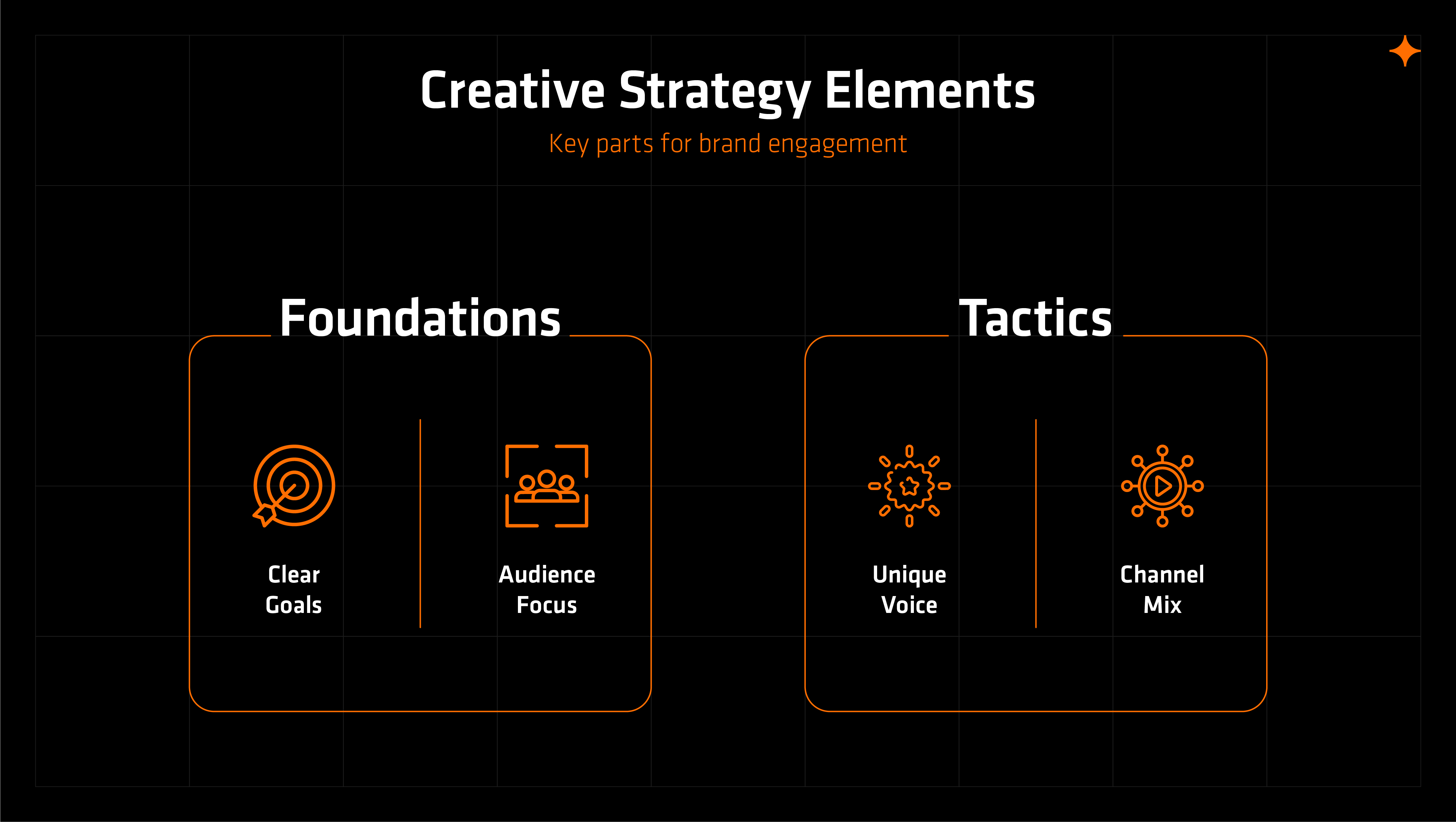
| Element | Description | Why it matters |
|---|---|---|
| Audience insight | Deep understanding of your audience’s behaviour, values, and motivations | Ensures creative resonates emotionally and practically |
| Clear objectives | Defined outcomes, whether brand awareness, lead generation, or conversion | Keeps creative decisions purposeful and measurable |
| Unique positioning | A distinct perspective or point of difference in the market | Prevents creative from blending into competitor noise |
| Emotional and rational triggers | Knowing which emotional drivers and logical reasons influence your audience | Allows you to balance persuasion and engagement |
| Channel integration | Matching creative approach to the right platforms and formats | Maximises reach and relevance across touch points |
| Measurement framework | Metrics tied to objectives, reviewed at set intervals | Enables real-time adjustment and long-term learning |
Here is a practical sequence for building your creative strategy from scratch:
- Start with the business problem, not the creative concept. What commercial outcome are you trying to achieve in the next quarter or year?
- Define your audience with precision. Go beyond demographics. What does your audience believe, fear, aspire to, and discuss in private?
- Identify your unique creative territory. Where can your brand say something that no competitor is saying convincingly?
- Choose your emotional and rational levers. What feeling do you want to leave the audience with, and what rational reason do you want them to hold?
- Map your channel strategy. Which platforms and formats give your creative the best environment to perform?
- Set clear measurement criteria. Define success before the campaign launches, not after.
Strategic clarity in crisis management for brands offers a compelling example of how the same elements that build a strong creative strategy also protect a brand when things go wrong.
Pro Tip: Before introducing any AI tools into your creative process, align your team on objectives and audience insight. As noted in industry research, strategic complacency is more damaging than AI-generated sameness. Clarity before prompting consistently yields stronger creative outcomes and prevents your team from defaulting to generic, data-safe mediocrity.
Adaptability is the final, often underestimated element. Markets in Dubai move fast. Consumer sentiment shifts. New competitors enter. A creative strategy that cannot absorb new signals and adjust without losing its core identity is a brittle strategy. Build in scheduled review points and give your team permission to evolve the approach based on what the data is actually telling you.

AI vs human creativity: Finding the winning balance
With the strategic foundation set, the next challenge is integrating the right tools and talent for standout results. The conversation around AI and creativity has become noisier and less useful in equal measure. Most of the debate misses the point. The real question is not whether to use AI. It is knowing precisely where AI adds value and where it dilutes it.
| Capability | AI strength | Human strength |
|---|---|---|
| Generating creative variants | High: produces multiple options quickly | Low: slower, resource-intensive |
| Original concept development | Low: relies on existing patterns | High: draws on lived experience and lateral thinking |
| Data analysis and testing | High: processes large datasets efficiently | Low: slower to identify patterns manually |
| Cultural nuance and authenticity | Low: can miss local or subculture context | High: essential for Dubai’s diverse market |
| Emotional storytelling | Low: lacks genuine emotional resonance | High: human voice creates connection |
| A/B testing at scale | High: built for rapid iteration | Medium: teams can do this but more slowly |
Industry research confirms that AI excels in generating variants and running testing cycles but consistently fails to deliver the original spark that separates memorable campaigns from forgettable ones. Hybrid approaches, where humans lead the concept and AI supports production and optimisation, are now demonstrating significantly better outcomes across the board.
For Dubai brands specifically, cultural authenticity is a non-negotiable. The city is home to more than 200 nationalities, and data’s role in branding shows that culturally specific insights consistently outperform generic, AI-generated messaging in both engagement and conversion.
A practical hybrid model works like this. Your human creative team develops the core concept, the narrative tension, the emotional territory, and the unique angle. AI then takes that approved concept and scales it: generating format variants for Instagram, LinkedIn, and out-of-home, running multivariate tests on headlines, and analysing performance data to inform the next creative iteration. This keeps the original thinking human while letting AI do what it genuinely does well.
Pro Tip: Use AI to accelerate your testing cycles, not to generate your original creative concept. When AI creates the concept, you risk producing the same output as every other brand using the same model with a similar brief. The advantage belongs to teams that use AI as a production and analysis tool, not as a replacement for strategic human thinking.
The brands winning in Dubai right now are not the ones using the most AI. They are the ones with the clearest creative vision, supported by smart use of technology at the right stages of their process.
Creative strategy in action: Real-world examples
With best practices outlined, let’s see how these strategies translate into impactful campaigns and real-world results. Theory is useful only when it is grounded in evidence. The following examples illustrate how clear creative strategy produces measurable brand lift and genuine commercial outcomes.
Bold positioning over safe messaging. Several international brands operating in the Gulf have moved away from consensus-seeking, inoffensive campaigns towards what researchers are calling polarised messaging. This approach involves taking a clear, sometimes provocative stance that deliberately appeals strongly to a specific audience segment while being indifferent to those outside it. The result is stronger emotional connection and significantly higher organic amplification. Bold, polarised creative strategies now dominate effective brand and performance outcomes in competitive markets.
Standout results driven by clarity. One of the clearest patterns across successful Dubai campaigns is the role of strategic simplicity. Brands that reduce their message to a single, unmistakable idea and execute it consistently across every channel consistently outperform those running multi-message, multi-objective campaigns. Audience attention is finite. A brand that says one thing memorably will always beat one that says five things adequately.
Key outcomes tied to a well-executed creative strategy include:
- Brand awareness uplift of 20 to 40% in competitive categories when campaigns are built on a distinctive, well-researched creative territory
- Customer engagement rates that are two to three times higher when emotional triggers are identified and integrated before production begins
- Return on investment improvements when measurement frameworks are built into the strategy from day one rather than added retrospectively
Statistic to note: Brands that align creative strategy with business objectives from the outset report significantly stronger campaign ROI compared to those that treat creative and strategy as separate work-streams.
Understanding successful agency collaboration can make a material difference in how quickly these results are achieved, particularly for brands that are building or rebuilding their creative approach. Reviewing influencer strategy examples also reveals how a clear creative strategy shapes even third-party content partnerships, ensuring brand consistency across creator-led campaigns.
The practical lesson here is straightforward: the brands that treat creative strategy as a living, commercially grounded discipline produce better results than those that treat it as a creative briefing document filed before production begins.
Why creative strategy requires both courage and discipline
Here is something the marketing industry rarely admits openly: most teams default to safe creative work not because they lack ideas, but because they lack the organisational courage to commit to bold ones. It is easier to produce a campaign that offends no one internally than to fight for an idea that challenges the category.
This is the uncomfortable truth about creative strategy in a dynamic market like Dubai. The city rewards distinctiveness. Its consumers are exposed to world-class brand communication every day, which means the bar for attention is genuinely higher. A strategy built on consensus, on ideas that make everyone in the room comfortable, will always underperform a strategy built on genuine creative conviction.
We have seen it repeatedly in our own work. The campaigns that clients are most nervous about in pre-production are often the ones that perform best in market. The instinct to soften, to add a caveat, or to appeal to a broader audience is almost always wrong. Strategic complacency is more damaging than any AI-generated output because it produces mediocrity with full human intention behind it.
The future of marketing leadership in the Gulf belongs to teams that combine rigorous strategic discipline with the courage to back bold creative decisions. Discipline without courage produces competent but forgettable work. Courage without discipline produces exciting but directionless campaigns. The winning combination is both, applied consistently.
Unlock innovative creative strategy for your brand
Ready to take the next step towards more effective creative branding and campaigns? Almost Impossible has been partnering with ambitious brands across Dubai and the Middle East since 2016, helping them build creative strategies that connect original thinking with commercial ambition.
We specialise in the kind of work that challenges comfortable assumptions and delivers results you can actually measure. From defining your creative territory to producing campaigns that hold their own in one of the world’s most competitive brand environments, our team brings both the strategic rigour and creative courage that modern brands need. Explore our brand partnerships and see how we have helped brands across the region turn bold creative strategy into tangible brand growth. Let’s build something worth noticing.
FAQs
What is a creative strategy in marketing?
How does AI enhance creative strategy?
What are the most important components of a creative strategy?
Is creative strategy only for big brands?
Why is strategic clarity important before using AI?
Recommended

Start a Project
Have a challenging brief? We thrive on the impossible. Let's build something world-class together.
Get in touch
Join the Team
Obsessed with details? We're always looking for world-class designers and engineers.
View openingsFollow the Journey
See what we're building, reading, and learning. Connect with us on LinkedIn.
Connect on LinkedIn